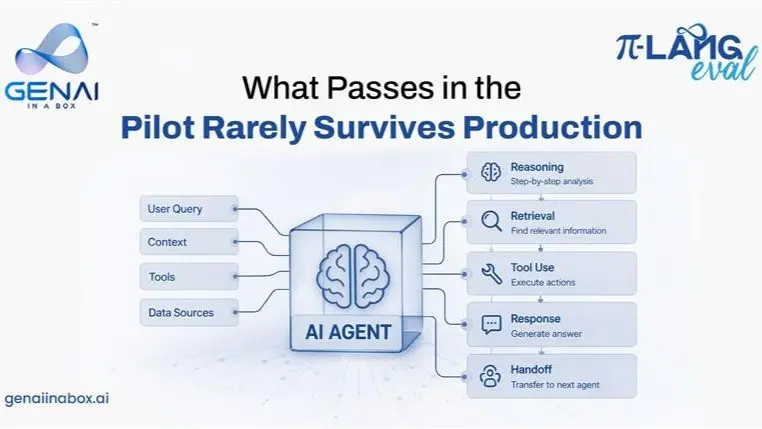
What Passes in the Pilot Rarely Survives Production
Here is the question most enterprises aren't asking loudly enough: after your AI agent goes live, do you know what it's doing?
Not whether it's running. Not whether the API is responding. Whether it is reasoning correctly, retrieving accurately, answering faithfully and doing all of that consistently, at scale, across every user interaction, every single day.
Most teams don't know. And that is a bigger problem than the model itself.
The Production Gap Nobody Talks About
90% of AI agents never make it successfully to production. That statistic comes not from pessimism but from a structural reality: the environments in which AI is built and the environments in which it operates are fundamentally different.
A demo runs on clean inputs, controlled scenarios, and a generous audience. Production runs on messy data, adversarial edge cases, and users who will push your agent in directions you never anticipated.
LLM outputs are inherently non-deterministic. The same prompt, given twice, can produce different outputs. That is not a bug it is the nature of the technology. But it means traditional monitoring is entirely insufficient. You cannot set a threshold on "correct" the way you set a threshold on latency.
51% of organizations using AI in 2025 experienced at least one negative consequence from AI inaccuracy not because the models were bad, but because nobody was watching closely enough to catch where reasoning broke down.
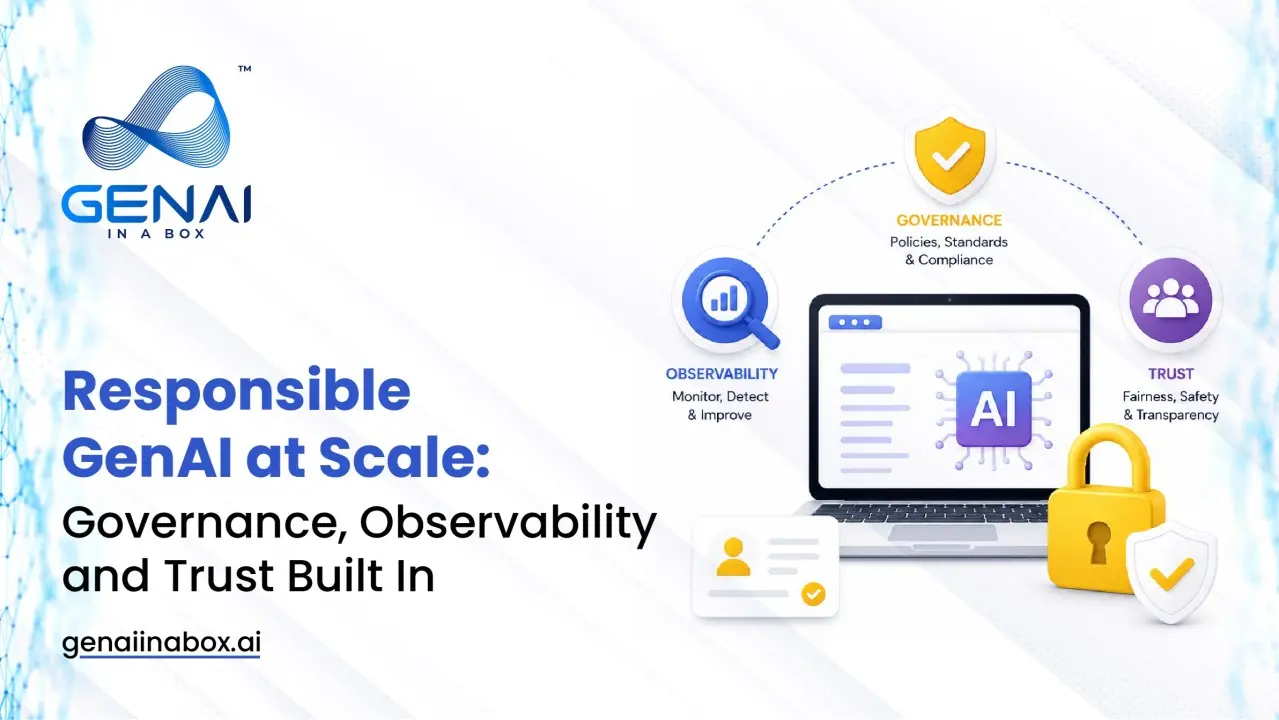
Monitoring Tells You Something Went Wrong. Observability Tells You Why.
A monitoring-only approach requires you to anticipate every failure mode in advance and build dashboards for it. An observability-first approach equips your team to investigate failure modes you did not anticipate because the system captures enough context to reconstruct exactly what happened.
For enterprise AI systems operating in dynamic, high-stakes environments, that difference is not academic. It is the difference between a team that debugs in minutes and one that debugs in days.
And in production Agentic AI where agents chain reasoning, call tools, make decisions, and hand off to other agents the failure surface is exponentially larger than a single LLM call. If you can't trace what each agent did, at which step it went wrong, and why the retrieval failed to surface the right context, you are operating blind.
The Evaluation Problem Is Even Deeper
You can see that your agent produced an output. But was it faithful to the source? Was it relevant to the question? Did it hallucinate a fact with high confidence? Did it use the right tool? Did it stay within compliance boundaries?
Quality issues are now the primary production barrier for AI agents, cited by 32% of organizations ahead of latency, cost, and integration issues.
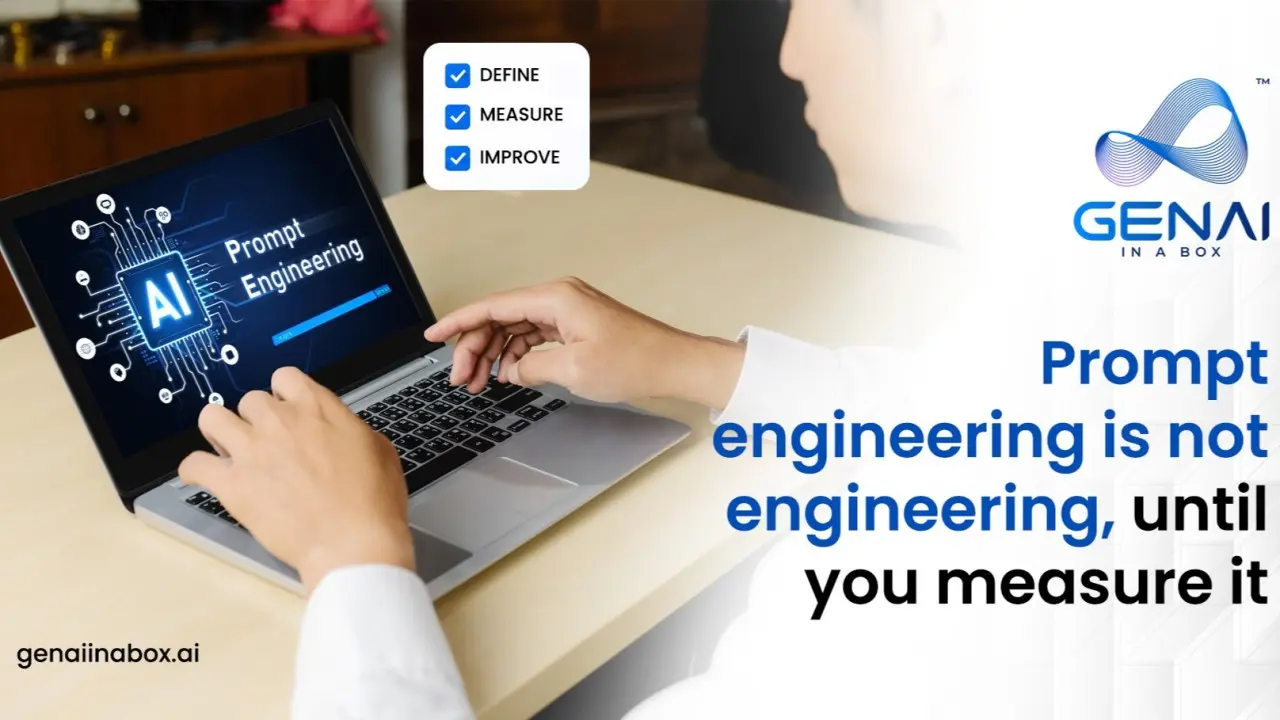
Most evaluation approaches today are manual, infrequent, and disconnected from production traffic. Teams evaluate 10 to 100 prompts in a sandbox and consider the system validated. That is not evaluation at enterprise scale. That is optimism with a spreadsheet.
Real evaluation needs to run continuously on production traffic, flag regressions before users encounter them, and feed insights back into the development cycle so each deployment is measurably better than the last.
Introducing π-LangEval: Built for This Problem
At πby3, we built π-LangEval specifically for enterprises who need to move beyond demo-grade confidence into production-grade trust.
π-LangEval is a Foundation Model Observability & Evaluation platform designed for Agentic AI workflows where the stakes are real, the data is complex, and auditability is non-negotiable.
Here is what makes it structurally different from generic monitoring tools:
Auto-Discovery of Agent Architectures: π-LangEval automatically inspects trace patterns to reverse-engineer your agent's structure inputs, outputs, child tools without manual configuration. You don't need to document your agent for the platform. The platform learns your agent.
Write Once, Run Anywhere Evaluation: A single evaluation config targets both live production tracing and offline dataset testing with one toggle. Your CI/CD tests become your production monitors instantly eliminating the costly parallel maintenance of separate testing and monitoring logic.
Curated Evaluator Library: A built-in marketplace of system-level evaluation templates hallucination detection, conciseness, faithfulness, answer relevance that teams can clone into their project in one click. No starting from scratch. No re-inventing industry-standard evaluation criteria.
Shadow Evaluation with Async Support: For Agentic workflows where results settle seconds after a trace finishes, π-LangEval's shadow mode handles delayed evaluation without race conditions ensuring scoring accuracy for the workflows that matter most.
Strict Dataset Management: Datasets are treated as golden samples with explicit schema contracts not loose CSV uploads. Data is validated before it runs. No garbage in, no garbage out.
Enterprise-Ready by Design: Native multi-tenancy, project isolation enforced at the API and database level, a customizable pricing engine for private and fine-tuned models, and full compliance and audit trail support. ISO 27001 certified infrastructure. Built for regulated industries from the ground up.
The Standard Is Shifting
89% of organizations have now implemented some form of observability for their AI agents. The question is no longer whether to instrument your AI it is whether your instrumentation tells you anything meaningful about quality, safety, and reliability.
Logging prompts and tokens is not observability. Watching latency dashboards is not evaluation. Real production trust requires a platform that connects what you see in production to what you test before deployment and feeds that loop continuously.
Enterprises that get this right in 2026 will not just have AI that works in demos. They will have AI they can defend in a board meeting, audit in a compliance review, and trust in a high-stakes workflow.
That is what π-LangEval is built to deliver.
If your AI agents are in production or heading there and you want to understand what they're doing, we'd welcome the conversation.
🔗 Explore π-LangEval → 🌐pibythree.com 📩 contactus@pibythree.com