When Gopal Renganathan joined Anywhere Real Estate the Fortune 500 parent of Coldwell Banker he inherited a familiar problem. AI pilots flourished everywhere. Marketing generated campaigns in minutes. Sales deployed predictive engines. Customer service automated thousands of interactions. Yet nothing reached production.
Legal flagged privacy concerns. Security raised data exposure questions. Compliance questioned model transparency. Each department protected its domain, but nobody owned the pathway forward. The result? 95% of enterprise GenAI pilots show no measurable P&L impact, according to MIT's 2025 study.
Gopal's insight changed everything: governance wasn't a barrier to velocity it was the vehicle.
The Manifesto Shift
Traditional governance focuses on uptime, security, and predictable ROI. AI introduces different dimensions: models that evolve unpredictably, outputs that appear authoritative yet may be fabricated, capabilities that improve or degrade without explicit programming.
Shelly Palmer, who advises Fortune 500 CEOs, crystallizes the shift enterprises need: "Your organization doesn't need another hundred-page policy document. You need a living declaration of principles, a manifesto that energizes while providing practical guidance."
Leading organizations establish five core components: strategic intent defining why AI matters to business purpose, first principles guiding all implementation decisions, accountability frameworks clarifying ownership, decision rights specifying approval authority, and learning mechanisms that evolve continuously.
The results speak clearly. Gopal's team at Anywhere Real Estate saw employee satisfaction jump 20 points, throughput multiply, and data search times drop 90%. Most importantly, AI initiatives started reaching production and generating revenue.
The Framework That Scales
Organizations crossing from pilot to production organize adoption across four layers. The strategic layer defines vision and identifies high-impact use cases measured in business terms revenue uplift, cost savings, efficiency gains. The design and governance layer establishes frameworks for responsible use while building technical foundations. The build and operate layer optimize model interactions and maintains reliability. The enablement layer upskills employees and addresses resistance.
77% of organizations now develop AI governance programs actively, with 47% ranking it a top five strategic priority. Yet challenges persist: 63% struggle keeping pace with AI evolution, 59% lack clear ownership, 52% face resource constraints.
The differentiator? Organizations with C-suite AI governance leadership are three times more likely to have mature programs. Kroger used governance-enabled AI to reduce checkout times by 50%. Microsoft's Satya Nadella revealed AI now writes 30% of their code velocity enabled by clear operational frameworks.
The Choice Ahead
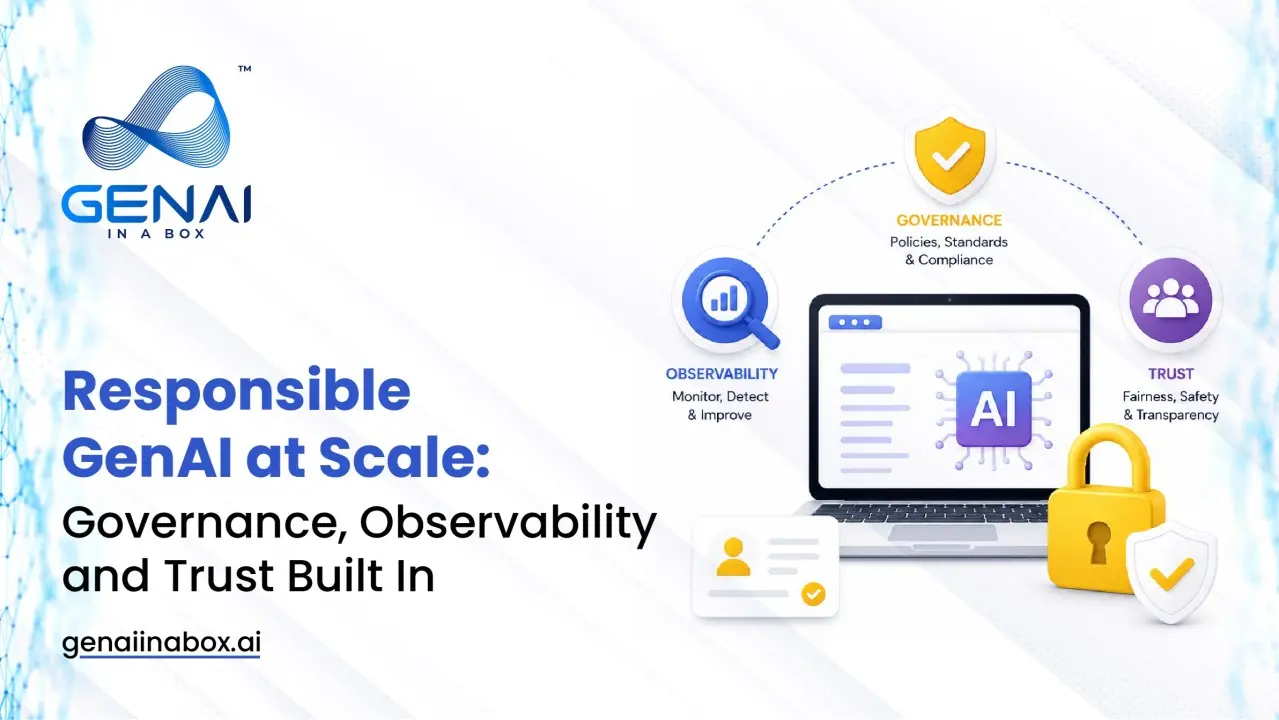
GenAI-in-a-Box operationalizes these proven governance principles. Instead of building frameworks from scratch, organizations deploy pre-configured governance structures with embedded best practices, risk-tiering, and operational oversight.
Governance isn't about restriction it's about acceleration through clarity. The leaders defining the next decade won't be those with the most AI pilots. They'll be those who turned governance into a growth engine.
Ready to move from experimentation to execution?
Connect with us to explore how GenAI-in-a-Box delivers governance frameworks that enable production-scale AI deployment without the 12-month buildout cycle.
Visit us at: https://genaiinabox.ai/